
COLORADO
WASHINGTON
EMDR/ART Therapy-Denver
EMDR Trauma Therapy-Washington
EMDR/ART Therapy-Fort Collins
Couples Therapy/Discernment-Denver
Couples Therapy/Discernment-Ft Collins
Couples Therapy-Seattle
How Does EMDR Therapy Help with Anxiety and Panic?

Work With Me
a licensed professional counselor with 15 years of experience in the field. I earned my B.S. in Psychology and Master’s in Counseling from Colorado State University and am the proud owner of Path to Growth Therapy and Trabelsi Coaching & Consulting.
I provide therapy for individuals and couples across Colorado and Washington, and mindset coaching and consulting services to clients worldwide. My specialties include grief, trauma, anxiety, life transitions, and relationship challenges. With a strengths-based, trauma-informed, and action-oriented approach, I help clients move beyond challenges and step into lasting healing and growth.

Meet Sheila
September 18, 2026
Table of Contents
- Anxiety Is Rarely “Just Anxiety”
- How EMDR Targets Anxiety Specifically
- What This Looks Like in Real Sessions
- Why This Can Succeed Where Talk Therapy Alone Hasn’t
- Anxiety Conditions Commonly Addressed with EMDR
- What Starting EMDR for Anxiety Involves
- Does EMDR Replace Medication or Other Treatment?
- About the Author
- Frequently Asked Questions
- Conclusion
Anxiety doesn’t always come with a clear origin story. Some people can point to a specific cause, a frightening event, a stretch of chronic stress, but for many, anxiety just seems to arrive and take over, with no obvious link to anything specific. EMDR Therapy is often associated primarily with trauma treatment, but it’s also widely used for anxiety and panic, precisely because so much anxiety has roots in unprocessed experiences the conscious mind hasn’t fully connected to current symptoms. In fact, many of the root memories might surprise you and even be about something completely different than you would expect.
Anxiety Is Rarely “Just Anxiety”
Anxiety develops for a lot of reasons, temperament, genetics, chronic stress, and life circumstances all play a role. But for many people, present-day anxiety is also tied to earlier experiences that taught the nervous system to expect danger, unpredictability, or a loss of control. A panic attack in adulthood might have no obvious trigger in the moment, but it can trace back to an earlier memory or pattern the nervous system never fully resolved.
EMDR works by uncovering these underlying threads, not to dig up old wounds for their own sake, but because processing them often reduces present-day symptoms in ways that coping strategies alone can’t fully reach.
How EMDR Targets Anxiety Specifically
While EMDR’s classic protocol was developed for trauma, it adapts readily to anxiety and panic through several key strategies:
Locating anxiety-linked memories. Even when someone can’t consciously connect their anxiety to a specific event, careful questioning during the history-taking phase often surfaces earlier experiences, a frightening medical event, an unpredictable household, a moment of feeling overwhelmed and unsupported, that may be contributing to the current pattern.
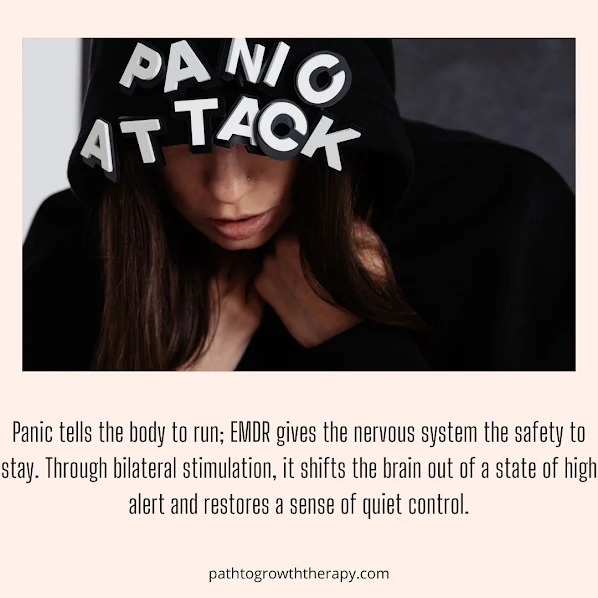
Processing the peak moment of panic. For panic disorder in particular, EMDR can target the memory of one especially intense panic attack, since the fear of a repeat episode often becomes its own self-sustaining loop.
Working with anticipatory anxiety. EMDR isn’t limited to past events, it’s also used with future-oriented fear, helping desensitize the anticipated response to an upcoming situation like a medical procedure, public speaking, or flying. While EMDR isn’t the top modality for OCD, it can help to work with anticipatory anxiety to lower it and build confidence. (Reach out today to learn more about other OCD modalities that Path to Growth Therapy Specialize in including I-CBT).
Building a calmer baseline. Beyond processing distress, EMDR includes techniques for reinforcing a felt sense of safety, giving clients something concrete to return to during high-anxiety moments between sessions.
What This Looks Like in Real Sessions
A client dealing with panic attacks might work with their therapist to trace back the very first time they felt that particular wave of physical terror, tight chest, dizziness, the fear of losing control. Even when that original moment happened years before panic attacks became a recurring pattern, processing it can reduce the intensity of current episodes, since the nervous system is no longer reacting to a memory it never finished processing.
Why This Can Succeed Where Talk Therapy Alone Hasn’t
Many people arrive at EMDR after years of understanding their anxiety intellectually without ever feeling it actually shift. They know their triggers, can explain their patterns fluently, and yet the physical anxiety response persists regardless. This is because anxiety often lives in the body and nervous system rather than purely in conscious thought, and EMDR engages that physiological layer directly instead of relying solely on cognitive insight to produce change.
Anxiety Conditions Commonly Addressed with EMDR
- Generalized anxiety disorder
- Panic disorder and panic attacks
- Social anxiety
- Specific phobias
- Health anxiety
- Anticipatory anxiety about upcoming events or decisions
- Performance-related anxiety, including for high achievers and public-facing professionals
What Starting EMDR for Anxiety Involves
Treatment typically begins similarly to trauma-focused work: a thorough history, identifying current triggers and symptoms, and building grounding and coping skills before moving into direct processing. From there, sessions focus on reprocessing the memories or beliefs most connected to your anxiety, alongside reinforcing calmer, more adaptive responses to the situations currently triggering panic or worry. Path to Growth Therapy likes to address Anxiety from different angles, addressing the root cause through EMDR or ART helping client’s to feel a decrease in symptoms, while also teaching tangible skills that reduce anxiety in the present moment, leaving clients to feel confident in their ability to manage anxiety.
Change isn’t always dramatic overnight, but many clients notice a gradual softening in the intensity and frequency of anxiety symptoms as key material is processed.
Does EMDR Replace Medication or Other Treatment?
Not necessarily, and it doesn’t need to. Some clients pair EMDR with medication management or other therapy approaches, and that combination can work well, in fact, research suggests that therapy and medication combined are the best treatment for anxiety; however, at Path to Growth Therapy, we understand that medication isn’t for everyone and respect your decision. We are happy to discuss options and provide referrals to consider medication if interested or curious, but medication is not required to work with us and we believe in your own willingness and dedication to attend therapy and use skills will help you reach your goals. The right path depends on the severity of your symptoms and is worth discussing with both your therapist and prescriber if medication is part of your care and you are part of that decision.
About the Author
Sheila Trabelsi is a Licensed Professional Counselor, Licensed Addictions Counselor, and EMDR and ART-trained therapist who believes therapy should be practical, personal, and grounded in real life. As the founder of Path to Growth Therapy, she works with individuals and couples across Colorado and Washington, drawing from trauma-informed care, EMDR, ART, somatic strategies, attachment-based approaches, and cognitive therapies. Her goal is to create a space where clients feel understood while also gaining the clarity, skills, and confidence to make lasting changes in their lives and relationships.
Frequently Asked Questions
Can EMDR help with panic attacks even if I don’t know what causes them?
Yes. Part of the process involves identifying underlying memories or patterns connected to panic, even when the connection isn’t obvious to you at first, you don’t need to arrive already knowing the cause.
How many sessions before anxiety symptoms start to shift?
It varies with the complexity of contributing factors, but many clients notice some change within several sessions, with continued improvement as deeper patterns are addressed.
Is EMDR only for anxiety with a clear traumatic origin?
No. It’s used for anxiety with and without an identifiable traumatic root, including anxiety that developed gradually or seems to have no obvious cause.
Can EMDR help with anxiety about a specific future event, like surgery or public speaking?
Yes. EMDR includes techniques designed specifically to reduce anticipatory anxiety about future situations, not just process past events.
Conclusion
At Path to Growth Therapy, we regularly work with clients whose anxiety has no obvious “cause”, and that’s exactly the kind of case EMDR was built for. If anxiety has been running your life despite your best efforts to manage it, this is a conversation worth having.
If anxiety or panic have been running the show no matter how hard you’ve tried to manage them, EMDR offers a way to work with your nervous system directly instead of trying to think your way out of a physiological response. Contact us with questions, or schedule your session to get started.
Leave a Reply Cancel reply
| Originally DESIGNED BY ADP
© 2026 PATH TO GROWTH THERAPY
| Privacy Policy
HOURS: Sundays 8 AM-1 PM
Monday 10 AM-3 PM
Tuesday 10 AM-3 PM
Wednesday 10 AM-3 PM
Thursday 10 AM-12 PM (varied)
Fridays/Saturdays Closed/Intensives Only
Limited Availability outside these hours.
REVIEW US HERE
(970)-344-9177
pathtogrowththerapyllc@gmail.com
| Website Disclaimer
| Terms

