
COLORADO
WASHINGTON
EMDR/ART Therapy-Denver
EMDR Trauma Therapy-Washington
EMDR/ART Therapy-Fort Collins
Couples Therapy/Discernment-Denver
Couples Therapy/Discernment-Ft Collins
Couples Therapy-Seattle
How EMDR and ART Therapy Can Help With Complicated Grief

Work With Me
a licensed professional counselor with 15 years of experience in the field. I earned my B.S. in Psychology and Master’s in Counseling from Colorado State University and am the proud owner of Path to Growth Therapy and Trabelsi Coaching & Consulting.
I provide therapy for individuals and couples across Colorado and Washington, and mindset coaching and consulting services to clients worldwide. My specialties include grief, trauma, anxiety, life transitions, and relationship challenges. With a strengths-based, trauma-informed, and action-oriented approach, I help clients move beyond challenges and step into lasting healing and growth.

Meet Sheila
September 21, 2026
Table of Contents
- Recognizing When Grief Has Become “Complicated”
- When Traditional Grief Support Isn’t Enough
- How EMDR Approaches Complicated Grief
- How ART Approaches Complicated Grief
- Grief That Involves More Than Sadness
- Grief Beyond Death
- What Change Actually Looks Like
- About the Author
- Is It Too Soon to Start This Work?
- Frequently Asked Questions
- Finding Room to Grieve Fully
Grief rarely follows a predictable path, isn’t linear, and for most people it eventually softens with time, support, and the natural process of mourning. But sometimes grief refuses to move, replaying on a loop, holding an intensity that time alone doesn’t seem to ease. This is often called complicated grief, and it’s an area where EMDR (Eye Movement Desensitization and Reprocessing) and ART (Accelerated Resolution Therapy) have shown real promise, particularly when a loss carries elements of trauma, suddenness, or unresolved conflict, or there is a difficult complicating factor about the person being grieved.
Recognizing When Grief Has Become “Complicated”
Ordinary grief, painful as it is, tends to shift over time, even slowly. Complicated grief tends to stay fixed. Signs often include:
- Intense, persistent yearning or preoccupation with the person who died
- Difficulty accepting the loss long after it occurred
- Feeling stuck
- Intrusive images or memories connected to the death itself
- Avoiding anything that serves as a reminder of the loss
- A sense that life has lost direction or meaning since the loss
- Intense guilt, anger, or a feeling of being frozen in time
This pattern shows up especially often after sudden, violent, or traumatic deaths, losses involving unresolved relational conflict, or situations where the mourner witnessed the death or its immediate aftermath.
When Traditional Grief Support Isn’t Enough
Grief counseling and support groups offer real value for a lot of people, space to talk, be witnessed, and connect with others navigating something similar which is in itself a powerful experience. But when a loss carries traumatic elements – a violent death, a sudden accident, a specific disturbing image from the aftermath – talking about it in detail can sometimes retraumatize rather than relieve, because the traumatic memory itself hasn’t been processed. For others, the pain is so deep and painful that tolerating the feeling is unbearable and they might try and avoid grieving completely. This is where EMDR and ART tend to offer something different.
How EMDR Approaches Complicated Grief
EMDR treats the traumatic elements of a loss much like it treats any other traumatic memory, targeting the most distressing images or moments connected to the death and using bilateral stimulation to reduce their emotional weight. This might include:
- The moment of receiving the news
- A specific image from the death or its aftermath
- Memories of unresolved conflict with the person before they died
- Guilt-based beliefs, such as “I should have done something differently”
By processing these specific, often intrusive elements, EMDR can lighten the traumatic charge enough that ordinary grieving, sadness, remembering, gradual acceptance, has room to unfold naturally, instead of being blocked by trauma.
How ART Approaches Complicated Grief
ART’s guided imagery work is especially relevant here. Clients sometimes revisit a distressing image connected to the loss and then consciously choose to replace it with something different, not to deny what happened, but to loosen the grip one frozen, traumatic image has held over the mourning process. Many clients describe finally being able to think of their loved one without immediately being pulled back into the moment of loss itself.
Both approaches often have elements of getting to have a conversation with the person who is passed, finding closure in their own way. Both approaches also teach the client, how to allow grief in, in small amounts, without overwhelming oneself, which builds confidence that they can think about their loved one and grieve properly. Over the years of working with cases of complicated, traumatic grief, I have seen client after client understand their grief differently, learn to live with it in healthier more productive ways, find meaning and purpose again, and new relationships with the persons they lost.
Grief That Involves More Than Sadness
Complicated grief often carries emotions people don’t expect or feel comfortable admitting, relief in certain circumstances, anger at the person who died, guilt over things left unsaid, even a sense of betrayal. Neither EMDR nor ART requires you to resolve these feelings intellectually before beginning. The processing itself often opens space for these more complicated emotional layers to soften and become easier to hold.
Grief Beyond Death
Loss doesn’t only follow death. Estrangement, an unresolved ending to a relationship, or the ongoing absence of someone who’s still alive but no longer present in your life can carry a similarly “stuck” quality, especially when there was no closure and no chance for repair. Both EMDR and ART are used in these situations too, targeting the specific memories and beliefs keeping the grief frozen.
What Change Actually Looks Like
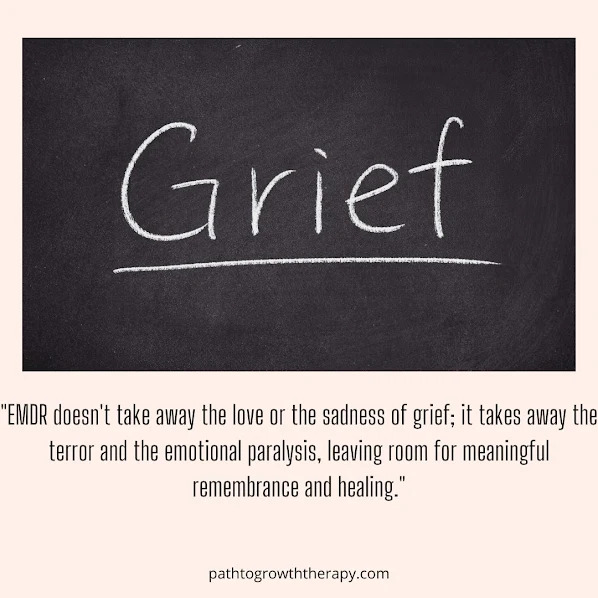
Progress in grief work doesn’t mean grief disappears; grieving someone you loved is a natural, ongoing part of having loved them. What tends to shift is the intensity and intrusiveness of it. Clients often describe being able to think about their loss, even feel sad about it, without being hijacked by intrusive images, panic, or overwhelming guilt. The grief becomes something you carry, rather than something that periodically takes over.
About the Author
Sheila Trabelsi is a Licensed Professional Counselor, Licensed Addictions Counselor, and EMDR and ART-trained therapist. As the founder of Path to Growth Therapy, she supports individuals and couples across Colorado and Washington using trauma-informed, EMDR, ART, somatic, and attachment-based approaches.
Is It Too Soon to Start This Work?
There’s no universal timeline. Some people benefit from beginning EMDR or ART fairly soon after a traumatic loss, particularly if intrusive memories are already interfering with daily functioning. Others need more time in initial mourning before trauma-focused processing feels appropriate. A skilled therapist assesses your readiness individually, rather than applying a one-size-fits-all rule.
Grief that won’t move is one of the more misunderstood struggles we see at Path to Growth Therapy. It’s not a sign you’re grieving “wrong”, it’s often a sign that something traumatic within the loss still needs to be processed, and that’s work we’re equipped to help you do.
Frequently Asked Questions
How do I know if my grief has become “complicated” versus just being a difficult, ongoing process?
If your grief feels frozen rather than gradually shifting, involves intrusive traumatic images, or has significantly impaired your functioning well beyond what feels typical for you, it’s worth discussing complicated grief specifically with a trauma-trained therapist.
Will EMDR or ART make me forget my loved one or feel less connected to their memory?
No. These approaches reduce the traumatic or intrusive charge connected to specific distressing moments, they don’t erase your memory of or connection to the person you lost.
Can EMDR or ART help with grief from a loss that happened many years ago?
Yes. There’s no expiration window on this work. Many people process grief from losses that occurred decades earlier, especially when the grief has remained stuck instead of easing over time.
Is it normal to feel guilty or angry, not just sad, during this work?
Very. Complicated grief often includes a wide range of emotions beyond sadness, and both approaches are designed to work with that full emotional picture rather than requiring you to feel only “appropriate” grief.
Finding Room to Grieve Fully
If grief has felt frozen, intrusive, or far more intense than time alone seems able to ease, EMDR and ART offer a way to process the traumatic elements holding it in place. Contact us to talk through what this could look like for your specific loss, or schedule your session to begin.
Leave a Reply Cancel reply
| Originally DESIGNED BY ADP
© 2026 PATH TO GROWTH THERAPY
| Privacy Policy
HOURS: Sundays 8 AM-1 PM
Monday 10 AM-3 PM
Tuesday 10 AM-3 PM
Wednesday 10 AM-3 PM
Thursday 10 AM-12 PM (varied)
Fridays/Saturdays Closed/Intensives Only
Limited Availability outside these hours.
REVIEW US HERE
(970)-344-9177
pathtogrowththerapyllc@gmail.com
| Website Disclaimer
| Terms

