
COLORADO
WASHINGTON
EMDR/ART Therapy-Denver
EMDR Trauma Therapy-Washington
EMDR/ART Therapy-Fort Collins
Couples Therapy/Discernment-Denver
Couples Therapy/Discernment-Ft Collins
Couples Therapy-Seattle
Mentally Checked Out in Your Relationship? Here’s What It Means

Work With Me
a licensed professional counselor with 15 years of experience in the field. I earned my B.S. in Psychology and Master’s in Counseling from Colorado State University and am the proud owner of Path to Growth Therapy and Trabelsi Coaching & Consulting.
I provide therapy for individuals and couples across Colorado and Washington, and mindset coaching and consulting services to clients worldwide. My specialties include grief, trauma, anxiety, life transitions, and relationship challenges. With a strengths-based, trauma-informed, and action-oriented approach, I help clients move beyond challenges and step into lasting healing and growth.

Meet Sheila
July 21, 2026
Table of Contents
- What Does It Mean to Feel Mentally Checked Out?
- Common Signs You May Be Mentally Checked Out
- Why This Happens
- Checked Out vs. Truly Done: How to Tell the Difference
- How Therapy Services in Colorado Can Help You Reconnect
- Why Online Therapy Services in Colorado Make It Easier to Start
- Final Thought
- FAQs
There’s a particular kind of exhaustion that doesn’t come from fighting with your partner. It comes from not feeling much of anything at all.
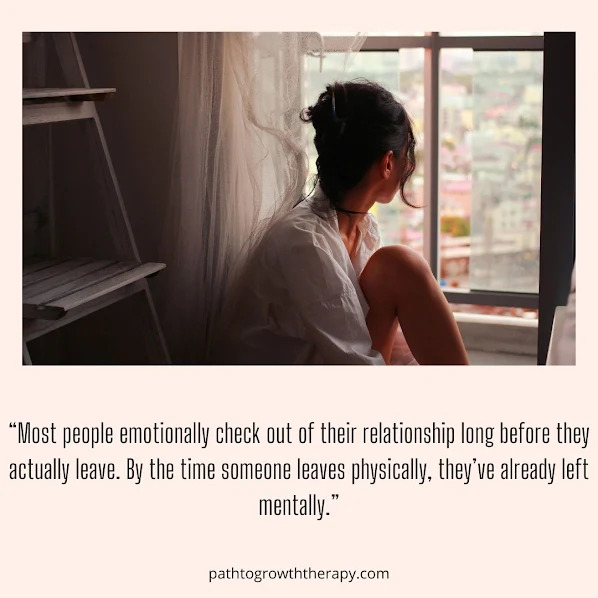
You’re still in the relationship. You still show up and go through the motions. But somewhere along the way, you stopped feeling present, and now you’re left wondering: am I mentally checked out?
If that question feels familiar, you’re not alone, and it doesn’t automatically mean your relationship is over. It often means you’ve been carrying something for too long without enough support to process it, which is exactly the kind of moment online therapy services in Colorado are built to meet you in.
What Does It Mean to Feel Mentally Checked Out?
Being mentally checked out is different from being angry or in the middle of conflict. It’s quieter than that: a kind of numbness or detachment that develops gradually, usually as a protective response to prolonged stress or unmet needs.
Instead of feeling hurt when something goes wrong, you feel nothing. Instead of engaging in a conversation, you disengage entirely, going through the motions without being emotionally present in them. It isn’t true indifference. It’s often exhaustion wearing indifference as a disguise, and for many couples, it builds quietly underneath the surface of an otherwise normal-looking life.
Common Signs You May Be Mentally Checked Out
You’ve stopped reacting. Things that used to upset you no longer do, not because they’ve been resolved, but because you’ve stopped expecting anything to change.
You feel like an observer. You’re physically present during conversations or family moments, but mentally, you feel like you’re watching from a distance.
You’ve quietly stopped trying. You’re not picking fights anymore, but you’re also not initiating connection, affection, or repair.
You feel relief when you’re apart. Time alone feels easier than time together, and you notice yourself avoiding closeness rather than seeking it out.
You’ve imagined life without this relationship. Not with intention to leave, but as a passing thought that keeps returning.
You feel guilty for feeling nothing. Many people feel frustrated with themselves for not caring as much as they think they “should.”
If several of these feel true, it’s worth taking seriously, with honest reflection rather than panic.
Why This Happens
Feeling mentally checked out rarely happens overnight. It’s usually the result of prolonged strain that was never addressed, and the roots often go back further than the relationship itself.
Chronic unmet needs. When emotional needs go unmet repeatedly, many people unconsciously lower their expectations as a way to stop being disappointed.
Overload and burnout carried home. Work stress that never fully switches off can quietly drain the mental energy a relationship needs to stay connected. This overlaps with what we cover in our piece on managing corporate burnout without sacrificing success, where the same exhaustion that shows up at work often follows people home.
Underlying anxiety. Persistent worry or a nervous system stuck in high alert can make mental withdrawal feel safer than staying engaged. If this sounds familiar, our guide on anxiety therapy in Colorado breaks down how anxiety symptoms can quietly shape relationship patterns.
Unresolved conflict. Arguments that never fully resolve teach both partners that conflict isn’t worth the effort, leading to quiet withdrawal instead of continued engagement.
Checked Out vs. Truly Done: How to Tell the Difference
One of the hardest parts of feeling mentally checked out is not knowing whether it means the relationship is over, or whether it’s simply a signal that something needs attention.
Feeling checked out often still comes with grief or longing for how things used to be. Being truly done tends to bring clarity and peace about moving on, rather than confusion. If you’re weighing whether to repair the relationship or walk away, these 10 questions can help bring clarity before you make a decision you’re not ready for.
How Therapy Services in Colorado Can Help You Reconnect
Feeling mentally checked out doesn’t mean you’re a bad partner, and it doesn’t mean the relationship can’t shift. It usually means the patterns underneath the disconnection haven’t been fully understood yet.
Working with a licensed therapist can help you:
- Identify what led to the mental and emotional distance in the first place
- Understand whether the checkout is protective or a sign of deeper burnout
- Rebuild emotional safety so vulnerability feels possible again
- Communicate what you’re feeling without shutting down
- Decide, with clarity rather than guilt, what direction feels right for you
Our Individual Couples Counseling Services are designed around exactly this kind of work, helping partners move from simply managing the relationship to genuinely understanding what’s happening beneath it.
Why Online Therapy Services in Colorado Make It Easier to Start
For many people who feel mentally checked out, the idea of sitting in an unfamiliar office and talking about numbness can feel like one more thing to push through. That’s part of why online therapy services in Colorado have become such an accessible starting point.
Virtual sessions let you begin the process from a space that already feels safe, without added pressure around scheduling or travel. For clients across Colorado, online therapy also means consistent support during the busiest, most emotionally depleted seasons of life, whether that season involves parenting, career pressure or grief that’s quietly affecting the relationship too.
Final Thought
If you’ve been asking yourself what it means to feel emotionally checked out, that question itself is meaningful. It often means part of you is still paying attention, even when it doesn’t feel like it.
You don’t have to figure this out alone. Sheila and the team at Path to Growth Therapy offer a complimentary 15-minute consultation to talk through what you’re experiencing and explore whether individual therapy, couples therapy, or an intensive session is the right next step. You can get in touch here with any questions.
FAQs
1. What does it mean to feel mentally checked out in a relationship? It means you’ve become disconnected or numb within the relationship, often as a protective response to unmet needs, unresolved conflict, or long-term emotional exhaustion.
2. Does feeling mentally checked out mean my relationship is over? Not necessarily. It often signals unresolved patterns rather than a final decision. Many couples reconnect once those patterns are understood and addressed.
3. How can I tell if I’m checked out or truly done with my relationship? Checked out often comes with guilt or longing, while being truly done tends to bring clarity and peace. A therapist can help you sort through which one fits your situation.
4. Can burnout or anxiety cause someone to feel mentally checked out? Yes. Chronic stress, work burnout, and untreated anxiety can all drain the mental and emotional energy needed to stay present and connected with a partner.
5. Is online therapy effective for mental and emotional disconnection? Yes. Online therapy services in Colorado let you begin processing this disconnection from a comfortable environment, which many clients find easier than an unfamiliar office.
Leave a Reply Cancel reply
| Originally DESIGNED BY ADP
© 2026 PATH TO GROWTH THERAPY
| Privacy Policy
HOURS: Sundays 8 AM-1 PM
Monday 10 AM-3 PM
Tuesday 10 AM-3 PM
Wednesday 10 AM-3 PM
Thursday 10 AM-12 PM (varied)
Fridays/Saturdays Closed/Intensives Only
Limited Availability outside these hours.
REVIEW US HERE
(970)-344-9177
pathtogrowththerapyllc@gmail.com
| Website Disclaimer
| Terms

