
COLORADO
WASHINGTON
EMDR/ART Therapy-Denver
EMDR Trauma Therapy-Washington
EMDR/ART Therapy-Fort Collins
Couples Therapy/Discernment-Denver
Couples Therapy/Discernment-Ft Collins
Couples Therapy-Seattle
Discernment Counseling: How to Know Whether to Stay, Separate, or Rebuild Your Relationship

Work With Me
a licensed professional counselor with 15 years of experience in the field. I earned my B.S. in Psychology and Master’s in Counseling from Colorado State University and am the proud owner of Path to Growth Therapy and Trabelsi Coaching & Consulting.
I provide therapy for individuals and couples across Colorado and Washington, and mindset coaching and consulting services to clients worldwide. My specialties include grief, trauma, anxiety, life transitions, and relationship challenges. With a strengths-based, trauma-informed, and action-oriented approach, I help clients move beyond challenges and step into lasting healing and growth.

Meet Sheila
May 26, 2026
Table of Contents
- What is Discernment Counseling?
- Why So Many Couples Feel Stuck
- What Happens in Discernment Counseling?
- Discernment Counseling Is Not About “Winning”
- Common Signs You May Benefit From Discernment Counseling
- How We Offer Virtual Discernment Counseling in Colorado and Washington
- Frequently Asked Questions About Discernment Counseling
“Should we get divorced?” “Can this relationship even be saved?” “Have I already stayed too long?” “Are we too far gone to fix this?”
If any of those questions sound familiar, whether you’ve said them out loud to your partner or just turned them over in your head at 2 a.m., you’re probably not asking on a whim. Most people who reach this point have been carrying it for a while: months, sometimes years, of disconnection, resentment, walking on eggshells, or just plain exhaustion. Maybe one of you is ready to walk away and the other is holding on tighter than ever. Maybe you’re both stuck, cycling through the same fight, the same silence, the same uncertainty, with no idea what comes next.
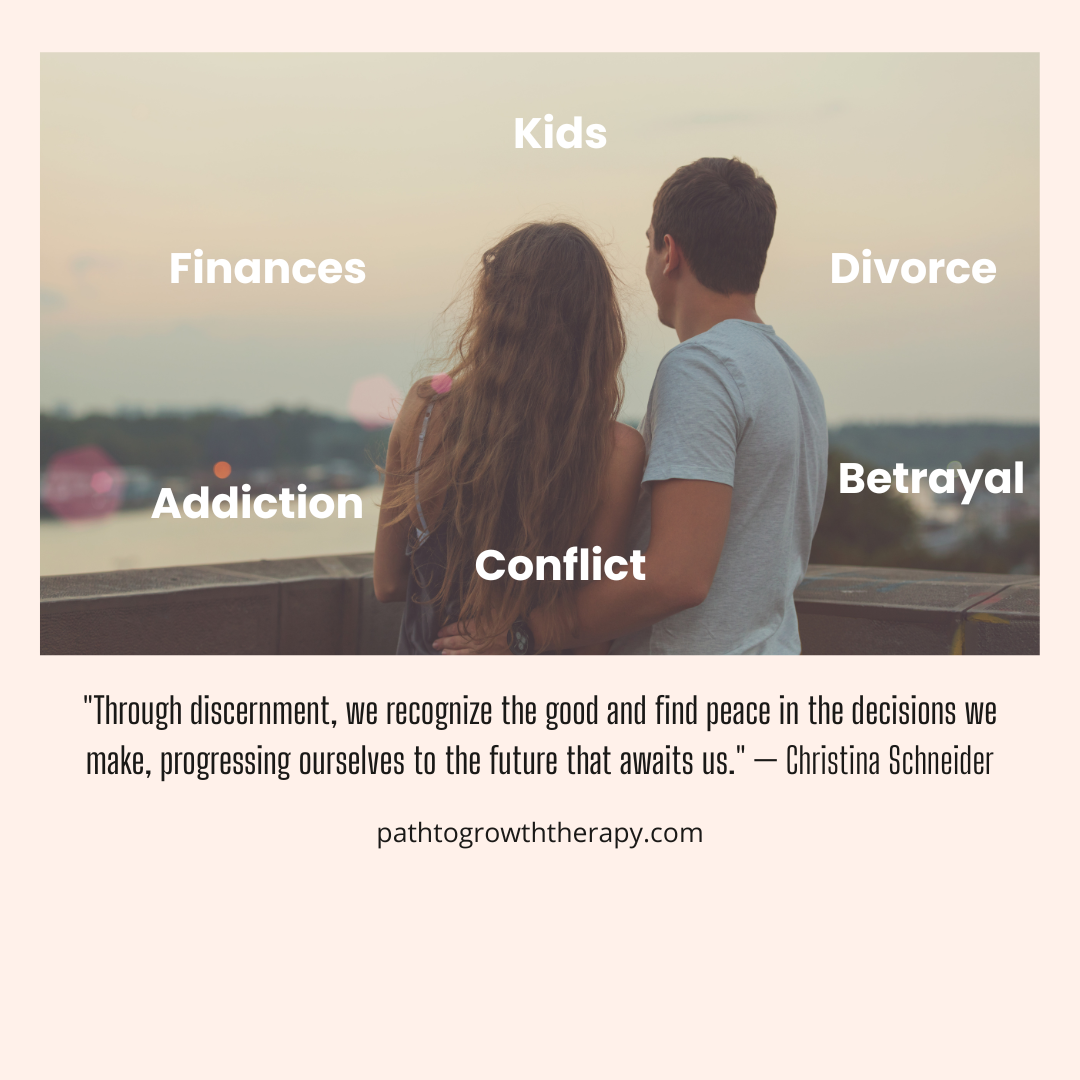
Add in the practical weight of it all, kids, a shared home, a life you’ve built together, the fear of starting over, and it’s no wonder so many couples freeze. Not because they don’t care, but because the stakes feel too high to get it wrong.
This is the exact situation discernment counseling was built for.
What is Discernment Counseling?
Discernment counseling is a brief, focused process for couples who aren’t sure whether they want to stay together, separate, or try to rebuild — and who need a clearer picture before they can decide. It isn’t designed to talk you into reconciliation, and it isn’t designed to talk you into divorce either. Its only real agenda is helping each of you understand, individually and as a couple, what you actually want and why.
That’s a different starting point than most couples therapy. Traditional couples work generally assumes both partners have already agreed to try to fix things and are ready to dig into communication patterns, rebuild trust, or reconnect emotionally. Discernment counseling happens a step earlier. Before any of that repair work begins, it helps you sort out which of three paths makes sense:
- Staying in the relationship as it is
- Moving toward separation or divorce
- Fully committing to focused intensive couples therapy to rebuild the relationship
For a lot of couples, this is the first time in a long time that the uncertainty itself feels manageable, not because the answer has arrived, but because there’s finally a structured way to get to one..
Why So Many Couples Feel Stuck
Search “how do I know if I should leave my marriage” or “signs my marriage is over” and you’ll find no shortage of couples asking the exact same thing. It’s an incredibly common place to land, and it usually shows up after a build-up of things: unresolved arguments that never really get resolved, emotional distance, infidelity, a loss of intimacy, or resentment that’s quietly been accumulating for years.
Often, one partner has been quietly weighing divorce for a long time before ever saying it out loud, which means the other partner can feel blindsided the moment it’s finally spoken. Other times, “maybe we should just get divorced” becomes something said in frustration during an argument, a sentence that gets repeated so often it stops meaning what it originally meant, even as the underlying stuckness stays real.
Therapists have a name for this dynamic: a “mixed-agenda couple.” One partner is leaning in, still fighting for the relationship. The other is leaning out, uncertain or already halfway gone. Traditional couples therapy often struggles here, because the two of you are essentially walking into the same room with opposite goals, one hoping to repair, the other still deciding if repair is even something they want.
Discernment counseling doesn’t try to force those two positions into alignment. It simply makes room for both of them to exist honestly, without either partner being pressured to commit to more than they’re ready for.
What Happens in Discernment Counseling?
This is meant to be short. Most couples complete the process in one to five sessions, not months of ongoing work.
Sessions typically alternate between time together as a couple and one-on-one time with each partner individually. That individual time matters, it gives each person room to be honest about where they really stand, without worrying about how it will land in front of their partner in the moment.
Rather than handing you communication homework or working through a specific conflict, the sessions are built around bigger-picture reflection, including questions like:
- How did the relationship get to this point?
- What patterns have kept pulling you apart?
- Has real repair actually been attempted before, or has it just been discussed?
- What has each partner contributed to the current dynamic?
- Is there genuine openness to rebuilding, on both sides?
- What would actually need to change for this relationship to feel healthy again?
- Is the desire to stay coming from love, or from fear, guilt, comfort, or obligation?
- If separation is the outcome, how can it happen in a way that’s thoughtful and respectful?
None of this is aimed at pushing you toward a particular answer. It’s aimed at getting you both to a place of clarity — a grounded understanding of the relationship, of yourselves, and of what you actually want to do next, instead of reacting from exhaustion or fear.
Discernment Counseling Is Not About “Winning”
A common misread of this process is that it’s just “pre-divorce counseling”, a formality on the way out the door. That’s not accurate. Discernment counseling is deliberately neutral. The therapist isn’t rooting for the marriage to survive, and they’re not steering you toward encouraging separation either. Their job is to help you both slow down enough to make a real decision rather than a reactive one made in the middle of a bad night.
For some couples, that slower, clearer process leads to a renewed willingness to fully commit to couples therapy. For others, it confirms that separating is genuinely the healthier path forward. And for many, the biggest win isn’t the decision itself, it’s the peace of knowing they actually explored it honestly, rather than guessing or reacting.
Most people want to know, deep down, that they gave the relationship a real shot before walking away. It’s incredibly common to look back and realize you stayed too long, not because you were confused about how you felt, but because of fear: fear of being alone, fear of losing the comfortable life you built, fear that no one else would love you the way you wanted to be loved, fear of the unknown itself. Discernment counseling gives you a structured way to actually test those fears against reality, and to honestly assess whether you and your partner have the willingness, bandwidth, and skill to keep working toward the relationship you want, or whether it’s genuinely run its course. Either way, it offers something valuable: a sense of closure, and a path forward that both people can respect.
Even couples who ultimately do divorce often say the process left them less hostile toward each other, better able to communicate, and more capable of co-parenting respectfully afterward.
Common Signs You May Benefit From Discernment Counseling
This process tends to be a strong fit if you recognize yourself in situations like:
- One of you wants to work on the relationship; the other isn’t sure they do
- Divorce or separation keeps coming up in conversation, again and again
- You’ve tried couples therapy before and it felt stuck or unproductive
- Infidelity, betrayal, or a deep emotional gap is part of the picture
- You feel trapped — not able to commit to staying or to leaving
- You swing back and forth between hope for the relationship and giving up on it
- One or both of you feel completely emotionally worn down
- You want real clarity before making a decision that will reshape your life
- You’re afraid of getting this decision wrong
- You genuinely don’t know if repair is even realistically possible at this point
One important caveat: discernment counseling is not appropriate in situations involving ongoing domestic violence or coercive control, or in cases where one partner has already made a final decision to divorce with zero openness to exploring alternatives. It’s designed for genuine uncertainty, not for situations where safety is at risk or a decision has already been made.
How We Offer Virtual Discernment Counseling in Colorado and Washington
We provide virtual discernment counseling for couples across Colorado and Washington (with more states coming soon), so you can get support from wherever feels most comfortable, usually your own home.
Meeting virtually tends to work especially well for busy professionals, parents juggling packed schedules, long-distance couples, or anyone who finds the idea of sitting across from each other in a traditional therapy office more intimidating than helpful.
We also recognize that once a couple decides they’re ready to do this work, waiting weeks between sessions can feel unbearable — especially when the uncertainty has already been building for a long time. For couples who want to move faster, we offer a discernment intensive format, condensed into one to three days. This lets you combine multiple sessions into a single extended weekend and walk away with real clarity, rather than stretching the process out over several weeks.
Meeting online also means you can:
- Get specialized support no matter where in the state you live
- Join sessions from separate spaces if that feels safer or more honest
- Skip the added stress of scheduling around drive time and logistics
- Stay consistent with sessions even during a genuinely hard stretch
- Start the process somewhere that already feels comfortable and familiar
Our approach throughout is direct, structured, compassionate, and free of judgment. We know how painful and disorienting relationship uncertainty can feel, and we’re not here to push you toward any particular outcome. Instead, we help you both slow down, get some real perspective, and make an intentional decision about where the relationship goes from here.
Discernment counseling isn’t only about the stay-or-go decision on the surface. It’s about understanding the deeper patterns, old wounds, fears, and hopes that got the relationship to this point in the first place, because that understanding is what makes the eventual decision, whatever it is, actually feel solid.
Frequently Asked Questions About Discernment Counseling
What is discernment counseling?
Discernment counseling is a short-term counseling process typically done in 1-5 sessions or in an intensive format, designed for couples who are uncertain whether to stay together or separate. It helps couples gain clarity and confidence about the future of their relationship.
How is discernment counseling different from couples therapy?
In traditional couples therapy, couples tend to go to therapy with the same goal in mind. Couples therapy focuses on improving the relationship and may last months or years depending upon your goals. Discernment counseling focuses on deciding whether both partners are willing and able to fully engage in repairing the relationship before beginning deeper couples work, or if other steps need to be taken instead of couples therapy.
How many sessions does discernment counseling take?
Most discernment counseling processes last between one and five sessions, depending on the couple’s needs and level of clarity.
Is discernment counseling only for married couples?
No. Discernment counseling can also help long-term committed partners who are uncertain about whether to continue the relationship.
Can discernment counseling help after infidelity?
Yes. Many couples seek discernment counseling after betrayal or infidelity when they are unsure whether trust can realistically be rebuilt.
What if one partner wants a divorce and the other doesn’t?
This is one of the most common reasons couples seek discernment counseling. The process is specifically designed for relationships where partners have different levels of commitment to continuing the relationship.
Does discernment counseling save marriages?
Sometimes. But the goal is not simply saving the relationship. The goal is to help couples make thoughtful, informed, and emotionally honest decisions about their future and the future of their relationship.
Can discernment counseling help us separate peacefully?
Yes. Even when couples ultimately decide to divorce, discernment counseling can help reduce blame, increase understanding, and improve communication during separation and co-parenting.
Do you offer virtual discernment counseling in Colorado and Washington?
Yes. We offer online discernment counseling for couples throughout Colorado and Washington.
How do we know if discernment counseling is right for us?
If you feel stuck between staying and leaving, if one partner is uncertain about the future, or if traditional couples therapy has not felt productive because of mixed goals, discernment counseling may be a helpful next step.
At the heart of discernment counseling is the belief that major relationship decisions deserve thoughtful reflection, not rushed reactions driven by fear, resentment, or emotional overwhelm. Whether couples ultimately choose repair, separation, or clarity about what comes next, the process can help create a more intentional and grounded path forward.
Schedule a consultation with us if you would like to explore further if discernment counseling is right for you and to take the next steps towards clarity.
Leave a Reply Cancel reply
| Originally DESIGNED BY ADP
© 2026 PATH TO GROWTH THERAPY
| Privacy Policy
HOURS: Sundays 8 AM-1 PM
Monday 10 AM-3 PM
Tuesday 10 AM-3 PM
Wednesday 10 AM-3 PM
Thursday 10 AM-12 PM (varied)
Fridays/Saturdays Closed/Intensives Only
Limited Availability outside these hours.
REVIEW US HERE
PATH TO GROWTH THERAPY
(970)-344-9177
pathtogrowththerapyllc@gmail.com
| Website Disclaimer
| Terms

